Monday, September 07, 2009

PCRM's 21-Day Vegan Kickstart program launches on September 8

Examiner.com

Your personal 21-day plan for going vegan

Examiner.com -
Tomorrow is the day! The Physicians Committee for Responsible Medicine (PCRM) launches their 21-Day Vegan Kickstart program on September 8. Sign up for free and you’ll receive daily tips and recipes to keep you informed, plus access to a discussion board to keep you motivated. Their website is packed with menu ideas and recipes.
The goal of the program is to help Americans adopt a more healthful diet and lifestyle for weight control and prevention of chronic disease. But it’s a great opportunity for anyone who wants to eliminate their use of animal products for a more ethical and compassionate lifestyle.
One caveat about the program; the recipes and menus are very low in fat. You can tweak them to suit your needs and tastes by choosing full-fat soymilk instead of nonfat and by using regular vegan salad dressings rather than nonfat ones. Sprinkle nuts and seeds onto salads or grain dishes, too; they can be an important part of a healthy vegan diet.
However you choose to use the kickstart program, if you have been thinking about going vegan, this is a great way to get the support that can make it happen!
Sign up here for the 21-Day Vegan Kickstart program (it's free) and check out resources for recipes and menus here.
For more information about vegan nutrition you might enjoy these articles:
Ten Tips For Healthy Vegan Diets
Getting Iron From Plant Foods
Building Healthy Bones On A Vegan Diet
Where Do Vegans Get Their Protein?

Your personal 21-day plan for going vegan

Examiner.com - 9 hours ago‎
The Physicians Committee for Responsible Medicine (PCRM) is challenging you to take their 21-day Vegan Kickstart, a program set up to help people adopt a healthy vegan lifestyle.  Starting Tuesday September 8, you are challenged to maintain a vegan diet for 21 days.  And they're guessing that you'll be feeling so good after just 21 days that you might just make a vegan diet a permanent fixture in your life!
Examiner.com


The Physicians Committee for Responsible Medicine (PCRM) is challenging you to take their 21-day Vegan Kickstart, a program set up to help people adopt a healthy vegan lifestyle.  Starting Tuesday September 8, you are challenged to maintain a vegan diet for 21 days.  And they're guessing that you'll be feeling so good after just 21 days that you might just make a vegan diet a permanent fixture in your life!

We've all heard that there is an obesity epidemic.  According to the CDC, in 2008 only one state had obesity rates below 20%.  Given the trend of the statistics for the rate of obesity, we can only assume that the obesity rate is still growing in 2009.  Obesity is the leading cause of heart disease and type-2 diabetes, as well as some types of cancer, respiratory problems, and an array of other illnesses.  According to the book Becoming Vegan by Brenda Davis, RD and Vesanto Melina, RD, vegans on average have much lower rates of obesity than do non-vegetarians, weighing nearly 10% less than their meat eating counterparts.

Overeating, and in particular overeating of unhealthy, nutrient deficient foods leads to many cases of obesity.  Most of these foods are high in fat, high in calories, and high in cholesterol.  Many of these unhealthy foods, like meat, cheese and other dairy products are physically addicting.  According to Dr. Neal Barnard, MD, author of Breaking the Food Seduction and President of PCRM, meat, cheese and other dairy products contain casomorphins, which attach to the brain's opiate receptors and cause an effect that is similar to opiate drugs such as morphine and heroin.  Dr. Barnard says that it can take just 3 weeks for these addictions to food to be broken, but that it's best to leave behind meat, cheese and dairy cold turkey, or more appropriately, cold tofu.  By eating these in moderation you are just setting yourself up for failure and relapse.  Just as you would with any drug you are addicted to, success requires stopping all together.

The PCRM is hoping that you will successfully break these food addictions and seductions on their 21-day Vegan Kickstart and be on the way to a happier, healthier you.  To sign up to participate in the Vegan Kickstart and to receive daily tips, recipes and motivation via e-mail, visit the PCRM's petition site.

Need support locally, or help finding vegan suitable foods?  Visit Rainbow Blossom Natural Food Market and speak with their helpful staff.  The staff at Amazing Grace Whole Foods and Nutrition Center will also be happy to help you.  Visit your neighborhood farmers market, and load up on fresh fruits and vegetables

For healthy vegan recipes visit: The Happy Vegan Yogini
More About: vegan · info · news

A happier, healthier you: The 21 day Vegan Kickstart.

Examiner.com - ‎Sep 6, 2009
The Physicians Committee for Responsible Medicine (PCRM) is challenging you to take their 21-day Vegan Kickstart, a program set up to help people adopt a ...

Images

Examiner.com
Examiner.com
Examiner.com
Examiner.com
Examiner.com
Examiner.com
Examiner.com
Wired News
Examiner.com
All related images »

Sunday, September 06, 2009

Corey Wrenn's critique of Vegan Outreach literature

Roanoke Vegan Examiner

A critique of Vegan Outreach literature


September
6, 9:37 PMRoanoke Vegan ExaminerCorey Wrenn


Downed calves
                   Downed calves:  direct result of the dairy industry.


Popular utilitarian welfarist group, Vegan Outreach, maintains that in order to help non-human animals now, we must adopt a strategy which aims to reduce suffering, regardless of means.  However, there are critical inconsistencies, misconceptions, and outright misuses of terminology which undermine any real benefit to non-human animals.  Despite their self-designation as a “[…] nonprofit organization dedicated to reducing animal suffering by promoting a vegan lifestyle,” Vegan Outreach in fact hinders veganism with notions of extremism and promotion of reductionism or vegetarianism.

Veganism as Extremist

Vegan Outreach states in their 2009 “Why Vegan” pamphlet:


Being vegan isn’t about being perfect or pure—it’s about reducing suffering (14).
 
The 2002 version states:


Being vegan isn’t about avoiding a list of ingredients […] (14).
 
The 2008 Guide to Cruelty-Free Eating furthers that veganism can be difficult:

[…] especially if you try to change too fast or hold yourself to too high a standard.  The important thing is to do the best you can (30).
 
It’s a good thing that society doesn’t hold the same low standards for rapists.  It would be great news for molesters everywhere if they could avoid moral obligations by simply doing the best they can.

Remember:  Continuing to eat cheese while avoiding meat and eggs does much more good than scrapping the whole idea because you can’t be completely consistent (Guide to Cruelty-Free Eating 30).
 
The implication in the above quotes is that veganism is somehow difficult, unobtainable, militant, or even utopian.  Rather than defining veganism as a moral refusal to participate in violence or the absolute baseline required for taking the exploitation and use of non-human animals seriously, veganism, is instead framed as one of many opportunities for reducing suffering.  In effect, this statement refutes the moral necessity of veganism and opens the door to reductionism.  If veganism isn’t about being perfect or pure, what’s the harm in sneaking a donut with your morning coffee?

Sneaking that whey-tainted donut might be acceptable for Vegan Outreach:

For instance, it can be prohibitively expensive and time-consuming to shun every minor or hidden animal-derived ingredient.  More importantly, avoiding an ever-increasing list of these ingredients can make us appear obsessive, and thus lead others to believe that compassionate living is impossible. This defeats our purpose:  ending cruelty to animals!” (Guide to Cruelty-Free Eating 2008: 24)
 
Apparently having moral consistency and absolute abstinence against an evil is obsessive.  Does the same go for child abuse, rape, murder, or cannibalism?  Would it be acceptable to beat a child to avoid appearing obsessive?  Is it impossible to completely abstain from beating a child?  Of course it is, and there’s nothing obsessive about holding abstinence from violence and wrongdoing as the absolute baseline.

Vegetarianism and Reductionism as Progress

We can already see progress in just the past decade—public concern for farmed animals’ interests and condemnation of factory farms, as well as more vegetarians, near-vegetarians, and vegetarian products (A Meaningful Life:  Making a real Difference in Today’s World 2008: 14)
 
Is reductionism and vegetarianism really progress?  Is the underlying moral injustice being addressed if we continue to participate in non-human animal use?  Is the focus on factory farms and the ignoring of exploitation in “humane” farming progress?

Despite the organization’s name, “Vegan” Outreach, the organization is merely an animal advocacy organization which utilizes veganism as one of many tools to reduce suffering:

In order to prevent the most suffering, it’s important we each take an approach we can sustain.  After reviewing this booklet, some people may decide to go vegan immediately; others may choose to eat fewer animal products and explore more vegetarian meals.  […] …veganism is best viewed as a tool for reducing suffering (Why Vegan 200914).
 
The notion of veganism, vegetarianism, and reductionism as mere tools is perhaps most evident in their publication and distribution of the “Try Vegetarian!” pamphlet:

[…] eating vegetarian is likely the most effortless—and enjoyable!—way to have a profoundly positive impact as often as every day” (Try Vegetarian 2003).
 
As an organization that openly advocates vegetarianism, is it really appropriate to operate under the name, “Vegan Outreach?”

Vegan Outreach’s 2008 “Guide to Cruelty-Free Eating,” intended for meat eaters, vegetarians, and vegans alike, presents a results-based approach:
When you first discover the reality of modern animal agriculture, avoiding all producers from factory farms might seem too big a change.  But don’t be overwhelmed—just take small steps.  For example, you could eliminate meat from certain meals or on certain days.  As you get used to eating less meat and find alternatives you enjoy, it may become easier to eliminate meat altogether (Guide to Cruelty-Free Eating 2008: 3).
 
As a vegan outreach organization, it seems strange that veganism is not promoted as a baseline, but here, reductionism is suggested to be morally acceptable and consistent. Furthermore, this statement specifically targets factory farming.  Support of “humane” farming, then, could logically be assumed by readers to constitute a “small step.”  After all, it’s all about reducing suffering, right?

Ultimately, living with compassion means striving to maximize the good we accomplish, not following a set of rules or trying to fit a certain label.  From eating less meat to being vegan, our actions are only a means to an end:  decreasing suffering (Guide to Cruelty-Free Eating 2008: 3)
 
Can reduction of suffering ever truly be accomplished and can abolition of non-human animal use ever be reached so long as so-called vegan organizations maintain that the exploitation of non-human animals is sometimes acceptable?


For every person you persuade to become vegetarian, dozens of farmed animals will be spared from suffering each year! (A Meaningful Life 2008: 23)
 
The argument that vegetarianism somehow makes a real difference for non-human animals is an empirical fallacy.  There is no continuum whereby vegetarians necessarily progress to veganism.  Further, vegetarianism does nothing to challenge the property status of non-human animals.  Often, vegetarianism causes more suffering than it reduces in that many vegetarians simply replace non-human animal flesh with non-human animal excretions.  Milk, eggs, and other non-flesh non-human animal products involve far more suffering than that of flesh.


Veganism as the Moral Baseline

Vegan Outreach posits:

The question isn’t, “Is this vegan?” but, “What is best for preventing suffering?” (Guide to Cruelty-Free Eating 3)
 
The answer to that question is:  “GO VEGAN.”  Veganism is the only moral choice if we truly want to reduce suffering, respect the moral standing of non-human animals, and ultimately reach total abolition of non-human animal use.  There’s nothing hard about it, there’s nothing obsessive about it, and there’s nothing inconsistent about it.
More About: abolition · animal rights · welfarism

Kimberly McCallum Files Suit Against Billy Graham Evangelistic Association

Black Woman Files Suit Against Billy Graham Evangelistic Association

Friday, September 4, 2009

(RNS) The Billy Graham Evangelistic Association has denied the claims of a black former employee who filed suit, alleging she was fired after expressing concern that the ministry was not sufficiently reaching out to African-American churches.
The racial discrimination lawsuit by Kimberly McCallum was moved Wednesday (Sept. 2) from a local court to a federal court, the Associated Press reported.
In response, the association issued a statement confirming the suit and saying it works to be inclusive.
"We cannot discuss the specifics of the pending case, except to state that we disagree with the allegations in the lawsuit," said the association, which is based in Charlotte, N.C. "The BGEA provides equal employment opportunities to people of all races. The organization continues to be inclusive of all people regardless of race, gender or nationality in all of the ministry's activities worldwide."
The suit was filed in June in a Mecklenburg County (N.C.) court, but was moved to a U.S. District Court in Charlotte.
According to the AP, the suit says McCallum complained that a list of 635 prospective congregations for a BGEA program included only three that were predominantly black.  She said she was fired a week later due to downsizing.  She seeks back pay, damages, and job reinstatement.
"Subsequent to her discharge, plaintiff learned that the global offices had not been downsized and that the only job that was eliminated there was the one occupied by the plaintiff," the suit reads.
Adelle M. Banks
Copyright 2009 Religion News Service. All rights reserved. No part of this transmission may be distributed or reproduced without written permission.

Advertisement
Add Comment » Comments
Tom
September 4, 2009 11:33 PM
But anyone who has seen him has seen the father :-)
This is a new wrinkle. Allegedly, she wasn't fired for her race per say. She was fired for 'rocking the boat' regarding outreach to people of her race. Does she have a case? Can the court determine that religious orgs that don't reach out enough to save souls of minority races are 'racist'? I'm very interested to see how this pans out. Granting her a judgment can have serious implications on church & state issues
nnmns
September 5, 2009 12:04 AM
It sounds to me, based only on this RNS article, like she has a case. If they tell her they are down-sizing but only down-size her, and that after she rocked a boat that probably hates rocking, that's some evidence. But I'm no lawyer.
cknuck
September 5, 2009 12:54 AM
I disagree Tom when you see Franklin you don't see Billy. I agree with you nnmns I think she does have a case if upon suggesting outreach to more Black churches they "downsized" her only with that cover up in mind. Here's the deal, her lawyer probably knows they will settle to avoid the negative publicity. Franklin has had to do bad decision damage control before.
Tom
September 5, 2009 9:08 AM
I agree that there's a wrongful termination case, given the minimal "downsizing". If it is, in fact, a racial discrimination suit, it would likely be necessary to prove that the "layoff" was significantly related to race and not solely because of her speaking out. But this article is very sketchy, which makes educated guessing next to impossible (and like nnmns, I'm no lawyer, but I play one in beliefnet comboxes ;-).
pagansister
September 5, 2009 8:46 PM
Adding here to the idea that she seems to have a case. I hope she wins it. The leadership will have some fancy stepping to do to get out of this one.
Read All Comments

Friday, September 04, 2009

Meatout Mondays - Every Week - Go Meatless on Monday

Meatout Mondays

Welcome to Meatout Mondays

Feeling sluggish?
Catching frequent colds?
Considering shedding a few pounds?
Want to help protect the environment and reduce global warming?
Troubled by animal suffering in factory farms and slaughterhouses?

Sounds like you're ready for Meatout Mondays!


Meatout Mondays
is a colorful weekly e-mail newsletter that delivers a delicious veg recipe, product suggestion, health news, and an inspiring story. Sign-up today and your first recipe will be sent this Friday (so you have time to get ready for Monday).

Want more? When you sign-up, you can also request your FREE Veg Starter Kit, a 32-page full-color magazine with details about the benefits of "kicking the meat habit" and helpful information on how to make the switch.
This is your opportunity to make a difference at every meal... a choice to improve your health, protect the environment, reduce global hunger, and save animals. Can't wait? Check out our past issues and 7-days worth of recipes to start.
Thank you for caring. Together, we are making better choices for a better world.
Get a free veg starter kit click here

Meatout Mondays is proudly sponsored by:

FARMIDA

Thursday, September 03, 2009

No beef with Julia’s kitchen: Her home’s new owner lacks the bone appetite


No beef with Julia’s kitchen

Her home’s new owner lacks the bone appetite

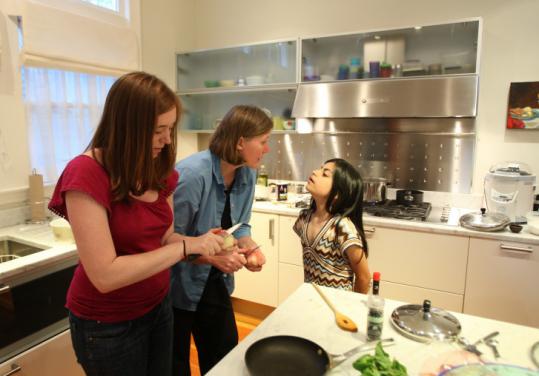
Lisa Landsverk and her daughters Rachael (left) and Teymura are among the new inhabitants of Julia Child's former house.
Lisa Landsverk and her daughters Rachael (left) and Teymura are among the new inhabitants of Julia Child's former house.(Essdras M Suarez/ Globe Staff)
By Billy Baker Globe Correspondent / August 31, 2009

CAMBRIDGE, Massachusetts, USA -
They are known for their love of cats.  At least they had that much in common.
But Lisa Landsverk, the new owner of the grand Victorian home on Irving Street in Cambridge where Julia Child, the doyenne of la cuisine bourgeoise, lived, cooked, and warbled for 43 years, has brought a bit of her own personality to the place.

Take the painting of the cow.

“Nobody says when I grow up I want to be a hamburger,’’ the painting’s caption reads.
Yes, the matriarch of Child’s former kitchen is an animal-rights activist and a vegetarian. “It’s a bit ironic,’’ Landsverk said, in an understatement.

What’s more, Landsverk is not what you would call a foodie. She likes to make simple things for dinner: pasta, burritos, reservations. But in the month since Landsverk and her husband, Harvard Law School professor Michael Klarman, moved into Child’s former home near the Harvard campus, they have found themselves the accidental caretakers of what has become a bit of a destination for food tourists.

Due to a recent movie about her life, “Julie & Julia,’’ everything Julia Child is hot. The film, based on a 2005 book by blogger Julie Powell about her attempt to cook all 524 recipes in Child’s landmark “Mastering the Art of French Cooking’’ in a single year, has catapulted Child, who died in 2004, back into the spotlight.

Child’s 48-year-old book has shot to the top of the bestseller list.

With the Julia mania has come an odd sort of attention for Landsverk, a former lawyer, and her family.

There are the lurkers outside their windows, snapping pictures of the house; the person who left a stick of butter (Child’s favorite ingredient) on their fence post; and the reporter who knocked on their door to ask what it’s like to cook on the site of hallowed culinary ground.

“The truth is that we haven’t done much cooking since we moved into the place,’’ Landsverk said.

After a bit of hesitation, she agreed to allow the reporter in to change that.

The plan was simple: Make a couple of Child’s recipes and see how it feels. Landsverk added one caveat: Everything had to be vegan because she did not want to offend her animal-rights friends. So, no butter.

Landsverk chose ratatouille for an entrée - she liked Child’s assertion that the eggplant casserole “perfumes the kitchen with the essence of Provence’’ - and, for dessert, pêches cardinal, a compote of fresh peaches with raspberry purée.

Helping her were daughters Rachael Klarman, 20, a junior at the University of Virginia, and 8-year-old Teymura.

A son, 17, was off at Japanese camp, and her oldest daughter, 22, was still in Charlottesville, Virginia, where the family lived before the move.

Rachael Klarman admits she had never heard of the famous chef before the realtor touted the Child connection to the family.

But she has become quite enthusiastic about the former occupant, recently reading “Julie & Julia’’ and Child’s memoir, “My Life in France.’’

As she walked back from a supply run to Savenor’s Market on a sweltering afternoon last week - Savenor’s was a favorite of Child’s, and she carved her signature signoff, “Bon Appétit,’’ into the sidewalk outside - Rachael Klarman said she’s been inspired to do more cooking in the kitchen, so that Child “is not rolling over in her grave.’’

Child and her husband, Paul, bought the house in 1956 for $35,000 and moved in two years later.

Paul, an artist and foreign service officer, designed the kitchen to Julia’s strict specifications, including countertops that were 2 inches higher than normal to accommodate her 6-foot-2-inch frame.

The kitchen was styled along the lines of a workshop, with the pots and pans hung from pegboards around the room, favorite knives - she had 800 - on magnetic strips between the windows, and everyday utensils in jars above the Garland range.

The pale green space changed little in Child’s time, and was familiar to many from the three cooking shows she filmed there during the 1990s.

When Child moved out in 2001, her kitchen and its contents were donated to the Smithsonian, where they are now an exhibit.

The house went through down-to-the-studs renovation, and when Lisa Landsverk and her family bought the 6,000-square-foot home in February for a reported $3.7 million, the only sign of Child’s tenure was her wine cellar, with its simple pine racks and handwritten vintage labels written by her husband.

The current kitchen is modern and white with a few stainless-steel accents. The windows and doorways are in the same place as when Child lived there, but the room has been expanded; an elevator has been removed to create a sunroom with a small dining area.

Stylewise, about the only thing the kitchen shares with Child’s is that everything has a place; in the new kitchen, that place is out of sight. Everything is so neatly concealed that Rachael said it took them a while to find the silverware drawer (it was hidden inside a larger drawer on the kitchen island).

With the ingredients ready and the cookbook open, Lisa and Rachael began making their way through the ratatouille recipe. Immediately, they realized that this was not going to be a quick meal.

“That’s very specific,’’ Lisa Landsverk said as she read Child’s directions to cut the eggplant into 3/8-inch-thick slices.

“No, there’s more,’’ Rachael Klarman said as she kept reading. “She calls for chunks with three specific dimensions. That’s impressive.’’

“And she wants us to dry each slice with a towel!’’ her mother gasped with a smile on her face. “We’re going to be here all day.’’

As they made their way through the recipes, mother and daughter began to notice a curious aspect to their conversation. They never said “the recipe wants’’ or “the book says;’’ they said “she says mind the heat’’ and “she wants us to chill the purée.’’ In “Julie & Julia,’’ Powell describes feeling that Julia was by her side like “some great big good fairy.’’
Lisa Landsverk and her daughter weren’t quite as grandiose, but agreed on one thing: Julia Child had them engaged with their dinner.

More than two hours after the cooking began, the kitchen was a mess but the food was ready. Teymura, who is chatty and a bit sassy, tried to get out of eating the ratatouille (she’d been pining for pasta), but relented when she was allowed to use chopsticks. She took one bite and announced “It’s kind of good, but not that good.’’

Rachael Klarman and her mother were more hesitant in their assessment.

After a few bites, Rachael said, almost relieved, “It tastes fine.’’ Her mother was impressed by the medley of flavors, but criticized her own technique.

“I think I overcooked the eggplant,’’ she said. “I wasn’t minding my heat like she said.’’
Correction: Because of an editing error, a Page One story yesterday about the owner of Julia Child's house gave the incorrect last name for the owner's daughter. Her name is Rachael Klarman.

http://www.boston.com/lifestyle/food/articles/2009/08/31/new_occupants_get_cooking_in_julia_childs_former_house?mode=PF